
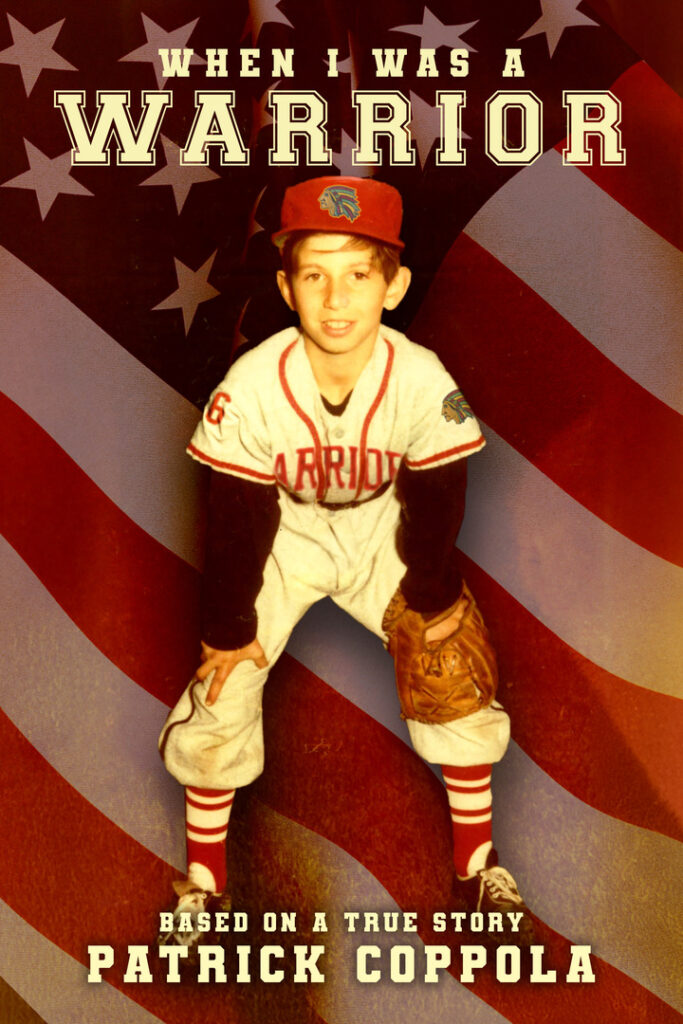
WHEN I WAS A WARRIOR – Written by Patrick Coppola
This work is unique. A strong coming of age story that will strike a nerve in baby boomers who lived through the Vietnam War, Kent State, Apollo 13, the Beatles break up, and the turbulent late 60’s and early 70’s, as well as paint a vivid picture to teenage and young adult audiences about life in America in 1970.
SYNOPSIS:
A 60 +-year-old man awakens from a restless sleep. He sits by his backyard pool, reflects on his life, and has a tug of war with his conscience. He’s unfulfilled, or so he thinks… Gazing into the night sky, he spots a shooting star, and reminisces of when he was a boy.
It is the spring of 1970, and 11-year-old Mickey Taylor is about to grow up in a hurry and watch his life take shape forever.
Mickey’s life is baseball. His team, the Warriors, are battling for a third straight championship. At school he battles daily with Sister Mary Ellen, a vindictive nun – trying to survive the final weeks of sixth grade. Home life is no better. His strained relationship with his tough-love styled father suffers due to constant problems at school and the fear of not living up to his father’s expectations on the baseball diamond. Mickey’s neighborhood idol, 20-year-old Johnny Spinelli returns from basic training for three days before heading to Vietnam. Johnny’s time home is cherished by Mickey. Johnny helps solve his hitting problems, and also teaches Mickey some very important life lessons. Before Johnny heads off to Vietnam he asks Mickey to keep an eye on 11-year-old Cheryl Fucci; Mickey’s schoolmate – a cute blue-eyed blonde who wears leg braces and whose older brother, Bobby, has recently died in Vietnam. Bobby was Johnny’s best friend and had asked Johnny to watch over his kid sister. Mickey reluctantly agrees – girls make him nervous. He is shy, and uncomfortable being around Cheryl. 11-year-old boys aren’t supposed to like girls, and his friend’s teasing causes a strain on their relationship.
Things seem to be on cruise control as the Warriors close in on their rivals, the Elks. Johnny’s hitting tips have given Mickey confidence. He is playing better than ever and writes about it to Johnny.
Curiosity about his favorite uncle, who he finds out is in a local prison, gets the best of him. He secretly visits his Uncle Phil, a fearsome but charming gangster. As their relationship grows stronger with each visit, his uncle asks a favor of him. Phil’s ex-cellmate, Teddy Green, decided to pull off a bank heist at a sleepy bank in Maine that Phil had told him about. Phil wants his share of the loot and sends Mickey to collect. Panic stricken, but not willing to let his uncle down, Mickey reluctantly faces Teddy Green. The seedy neighborhood is frightening. Teddy Green – a mean looking nasty sort, is confused when he sees who Phil Taylor has sent to collect his share, but he knows what Phil will do to him once he’s out of prison. After collecting payment from the bank robber, Mickey is jumped by neighborhood kids, only to be rescued at the last second by Teddy Green, who hollers at them from his window. When Mickey visits his uncle, he’s expecting praise, but Uncle Phil is not happy with the amount and tells him, “Go back” – not once… but twice. Finally, after three scary trips to Teddy Green’s apartment, his uncle is satisfied and the debt is resolved. Mickey realizes after those frightful trips that he was never in any danger, because of who is uncle is.
*****
Uncle Phil looked at me. “You did great, kid. I asked a lot from you, because I knew you were special, and I knew you were afraid at the beginning.”
“I was Uncle Phil. I was scared. Teddy Green said that you have balls of steel, and that I have them, too. What did he mean?”
Uncle Phil got closer to me. “Tell me something… are you afraid anymore?”
I looked into Uncle Phil’s piercing eyes. “I’ll never be afraid of anything, ever again.”
“You’ll be afraid again, but the difference is, you know how to face it now.” Uncle Phil smiled from ear to ear. “Having balls of steel goes a long way in life.”
I understood.
*****
Mickey survives his first school dance; he defends Cheryl by punching out a bully and begins to bond with her. She’s his first crush and he likes the feeling. In a must win game Mickey makes a diving catch to win it but injures his arm badly when he lands on a chunk of broken glass that was hidden by the outfield grass. Forty stitches later, the doctor tell him his baseball season is over. He is shattered. When news from Vietnam arrives, it is catastrophic. Johnny has been killed. It is 11-year-old Cheryl, who has already dealt with her brother’s death, who keeps Mickey together. With Johnny’s death, problems at home, the daily troubles he faces with his nun at school, and not being able to finish his baseball season, Mickey loses faith in God and in himself.
When the Elks lose their final game creating a playoff for the championship, Mickey couldn’t care less. Baseball doesn’t matter to him anymore. He withdraws from his friends and family and frequently visits Johnny’s grave… waiting. Before Johnny left for Vietnam he told Mickey that he’d always be there for him, no matter what happened to him, and that Mickey would always be able to see him and feel him. Mickey waits and waits for Johnny in the pouring rain, staring at the gravestone for Johnny’s spirit to appear; to come to him, but it doesn’t. He pleads to Johnny.
*****
“Why can’t I see you, Johnny? I know you didn’t lie to me. The Beatles broke up. Can you believe it? The Bruins won the cup. I got in trouble because I skipped school and went to the parade. We forced a playoff with the Elks. I cut my arm real bad and can’t play anymore. How about that, huh? All that effort, all the worrying, and I can’t even play. It was all for nothing… all for nothing. It’s all just for nothing… isn’t it? Where are you, Johnny?”
*****
After hours of desperately trying to see Johnny, and soaked to the bone, he hops on his bike and rides home.
Trying to lift his spirits, his mother surprises him with The Beatles’ last album, Let It Be. He rushes to Cheryl’s house to listen to it with her. They talk about Cheryl’s brother, Bobby, and Johnny and how and why they were dead. Their feelings are mixed, confused, and frightening. Cheryl, who has been Mickey’s rock, begins to cry, igniting something in Mickey he’d never felt before. Now, he needed to be her rock. Mickey clumsily tries to hug her, but somehow it turns into an awkward kiss – their first kiss. Panicked, Mickey jumps off the couch, backs away from her, and slowly eases into a chair, unsure of what had just happened. Whatever he did worked – Cheryl stopped crying and was smiling.
*****
“What just happened?” I asked nervously.
Cheryl giggled. “I just had my first kiss.”
“Me too.” We sat quietly looking across the room at each other. My head was swirling and I felt nauseous. “I gotta get home for supper,” I said. “Can I have one more kiss?” she asked.
“No.”
*****
During art class, the kids are instructed by Sister Mary Ellen to send homemade greeting cards with messages of support to President Nixon about the war. Less than thrilled, still confused about the war, and seeing Cheryl’s sad face – he creates a gruesome cartoon of President Nixon’s head being blown away by gun fire with the caption, Mr. President: You said no more would be dead – how about a bullet in your head? The nun flips her lid, but he stands up to her, leading a classroom revolt. When his father is summoned to the school, he’s expecting the worst. Mickey listens from down the hall and is shocked to hear his father defend his actions. On the ride home Mickey realizes he has underestimated the love and support he has always had from his father. Cheryl is waiting on his front steps when his father drops him off at his house. Tonight is the championship game and she tells him that his team needs him and that if she had the ability to play like everyone else she wouldn’t waste it. Mickey sees how Cheryl’s leg braces have hindered her and is afraid to permanently damage his arm. She challenges his fears.
*****
“Can you play tonight?”
“You blind? You see my arm. I can hardly bend it. The doctor said I could mess it up for good if I get hurt again.”
“It’s just a bad cut.”
My eyes widened. “Just a bad cut, huh? You think I wanna go through life with a bad arm?”
Cheryl looked at me honestly. “And end up like me? Is that what you’re afraid of?” she asked striking a nerve.
“I’m not afraid of anything!”
“Then play.”
“What’s wrong with you people?”
“It’s the big game and they need you.”
“Baseball doesn’t matter.”
“Of course, it matters. You wouldn’t have dove for that ball if it didn’t.”
“It mattered then. It doesn’t anymore.”
Her face hardened. “Stop feeling sorry for yourself.”
I’d heard enough and headed up the walkway. “Go home.”
She turned to me. “I wish I could play baseball. Just run around like everybody else.”
I stopped. “Wish? Everybody wishes for something they can’t have. Stuff that’ll never happen.”
“Some of my wishes have come true,” she said, and paused as if trying to hide something.
“Like what?” She didn’t want to answer.
“Like what?!”
Her jaw tightened and she blurted out. “I wished for rain.”
“What?”
“You heard me! I wished and prayed for rain so your arm could heal in time for you to play.”
My heart sunk. How could she believe that? Kindly, I could only shake my head. “It was just the weather.”
“No, it wasn’t,” she pronounced, trembling with tears in her eyes. “Don’t you wish? Don’t you pray?”
I didn’t want to hurt her, but I couldn’t lie. “Not anymore.”
“Well you better start again.”
“What do you know?!”
“I know plenty!”
I was frustrated. “Girls!”
I slammed the door shut leaving Cheryl alone on the steps. From behind the front hall curtain I watched her. She sat for a while and then lifted herself up with the aid of the handrail. She struggled down the steps and awkwardly began her walk home. I felt badly about the argument and wanted to chase after her to apologize, but the fear inside of me held me back. Instead, I went up the stairs. There was no one home which was a relief to me. I entered my bedroom and stood over my crumpled Warriors uniform, and then began kicking it all around the room.
*****
After some soul searching he decides to play in the game without telling his family. On his way to the park, Mickey passes Cheryl’s house. She’s excited to see him in his uniform. He notices the black headband on her head and asks to borrow it.
*****
When his father gets home and notices his uniform is missing he rushes to the park.
*****
My father had made his way to the side of the dugout and watched me field a ground ball and throw it home. After two weeks of not playing my arm didn’t feel strong. Hustling in, I approached him with my head down. “You mad at me?”
“Are you kidding? How’s it feel?”
“It hurts a little when I straighten it,” I said hiding the pain.
“It’ll loosen up.”
“Like you said. I couldn’t let my coaches down. Wouldn’t be fair. Who was gonna play second base? Alan or Pete? The team would kill me. And I don’t like Grande, either.”
He noticed the black armband on my sleeve and helped pull it up a bit and straighten it out. “This is a nice touch. You got a lot of class for an eleven-year-old kid. You can dedicate this game to Johnny.”
I looked warmly into my father’s eyes. “The armband’s for Johnny, Dad. I’m dedicating this game to you.”
For the first time in my life, I saw tears swell in the eyes of the toughest man in the world, and he stood speechless until he choked out, “Go get ‘em, son!”
*****
The game is an up and down pressure-packed battle, while Mickey struggles with physical and emotional pain before his team, family, and friends. The Warriors triumph and so does Mickey whose life has taken shape forever. Mickey Taylor awakens from his dream and realizes that he got everything he wanted from his life. He’s made the best of it.
Thanks for taking the time to read this synopsis. The screenplay and manuscript are ready for your review.